




 Calculator Tools












Google Search Console Social Media Guide: July 2026

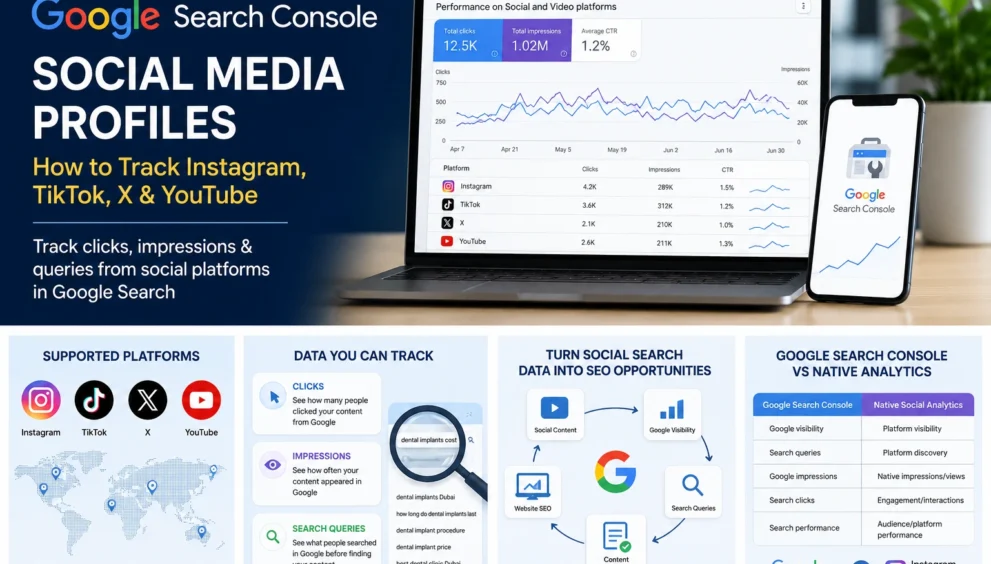
Google Search Console has traditionally been one of the most important tools for understanding how websites perform in Google Search. In 2026, however, Google expanded that concept beyond traditional websites.
With Platform Properties in Google Search Console, creators, brands, publishers, and digital marketers can gain insights into how content published on supported social and video platforms performs across Google surfaces.
This development is particularly important for businesses investing in Social Media Marketing Services Dubai because social content can now provide additional search performance insights alongside traditional website SEO.
That means your SEO strategy no longer needs to focus exclusively on pages hosted on your website. If your Instagram posts, TikTok videos, X posts, or YouTube content appear in Google, Search Console can provide additional information about how people discover that content.
In this guide, we’ll explain what Google Search Console Platform Properties are, which social platforms are supported, what data you can access, how the feature differs from native social media analytics, and how marketers can use this information to improve their content strategy.
What Are Google Search Console Platform Properties?
A traditional Google Search Console property represents a website or part of a website that you control.
For example:
example.com
A Platform Property extends the concept to a creator or organization’s presence on a supported social or video platform.
According to Google’s official Platform Properties announcement, the feature helps site owners and creators understand how their social and video posts perform across Google Search and other supported Google surfaces.
Instead of analyzing only pages published on your own domain, Google Search Console can provide information about eligible content associated with your presence on platforms such as Instagram, TikTok, X, and YouTube.
Platform Properties do not turn Google Search Console into a complete social media analytics platform. Instead, they provide another perspective: how your social and video content performs when it appears across Google surfaces.
For SEO professionals, this creates a connection between website search performance and social content discovery.
Businesses already investing in SEO Services in Dubai can use these additional search signals to identify topics and queries that may deserve deeper coverage on their websites.
Which Social Media Platforms Does Google Search Console Support?
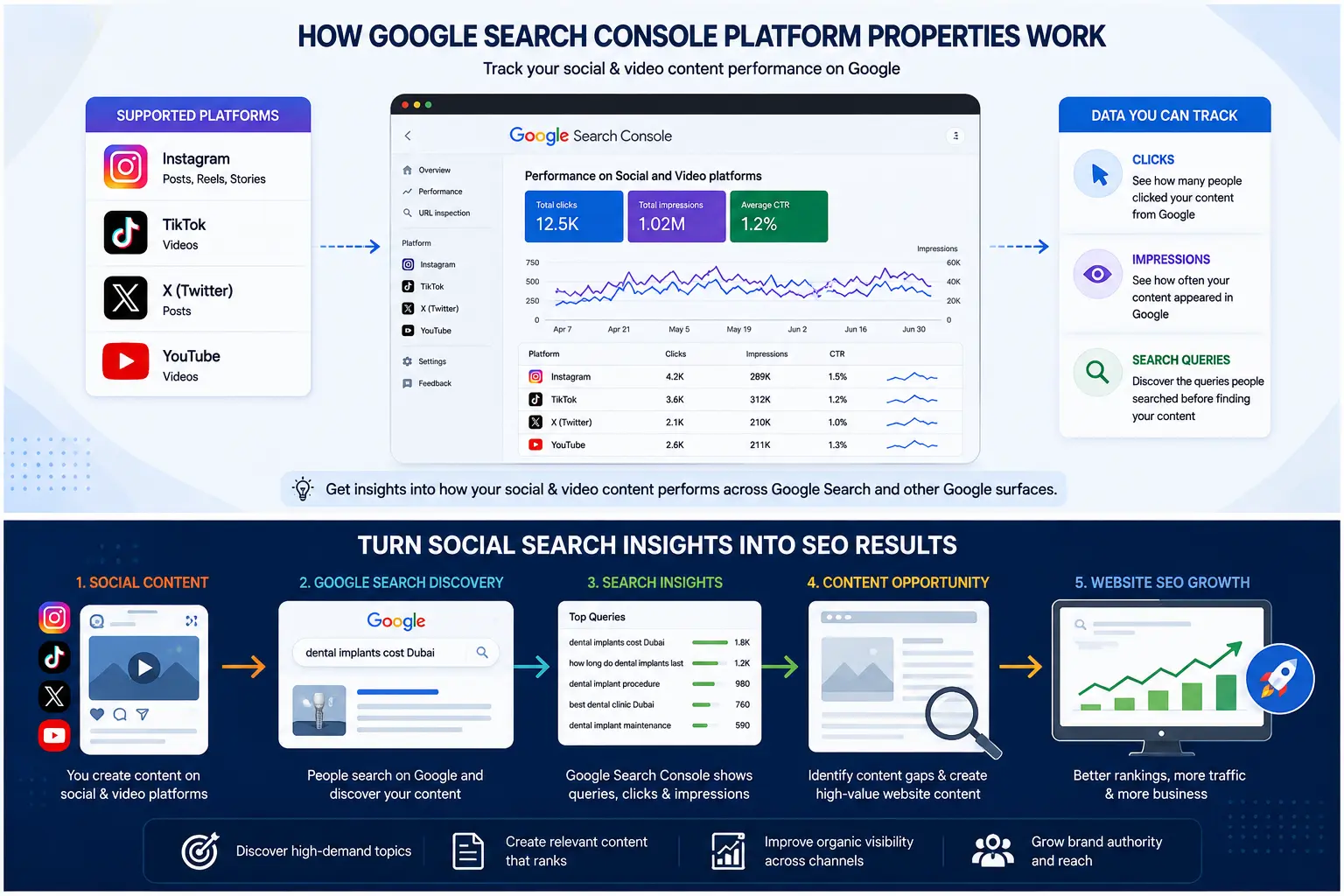
Google currently supports four major social and video platforms through Platform Properties:
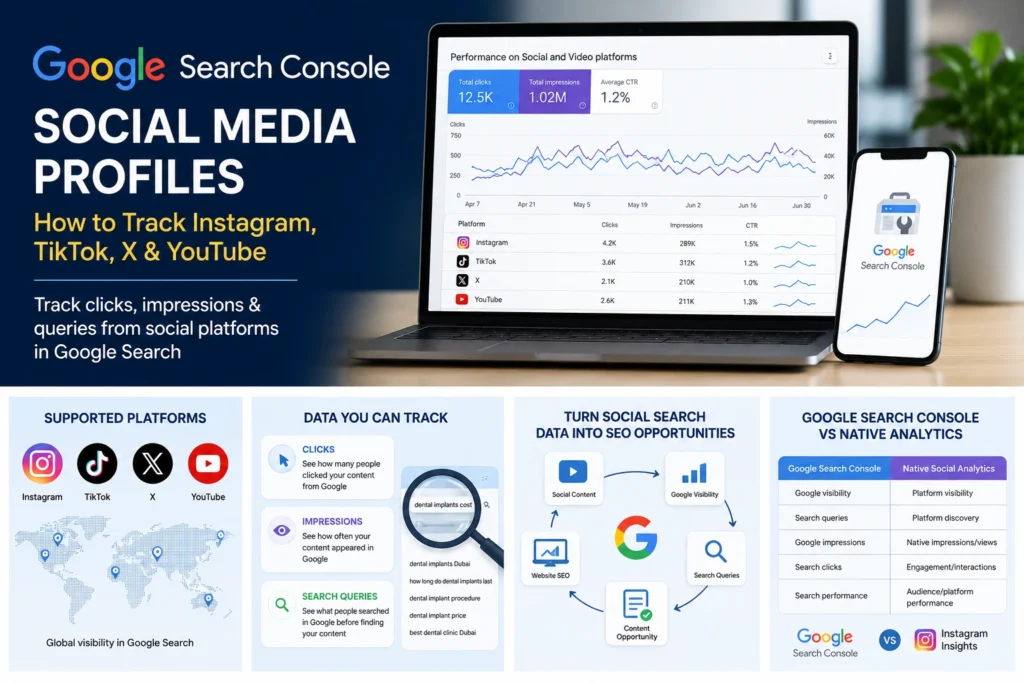
Creators and brands can understand how eligible Instagram content performs when discovered through Google.
This can be particularly useful for businesses publishing educational posts, Reels, product content, local information, tutorials, and other searchable content.
TikTok
TikTok has become an important content-discovery platform. Search Console provides an additional perspective on eligible TikTok content being discovered through Google rather than exclusively through TikTok itself.
X
Content published through X can also be associated with a Platform Property, providing additional visibility into Google-driven discovery.
YouTube
YouTube is particularly interesting from an SEO perspective because videos frequently appear within Google search experiences.
Search Console data can therefore complement YouTube Studio by providing additional insight into Google-driven video discovery.
Google currently identifies Instagram, TikTok, X and YouTube as the supported platforms. See Google’s official documentation
How to Add a Social Media Profile to Google Search Console
Setting up a Platform Property is relatively straightforward.
Step 1: Open Google Search Console
Sign in to the Google account you use to manage Search Console.
Step 2: Open the Property Selector
Use the property selector and choose the option to add a new property.
Step 3: Select a Platform
Choose one of the supported social or video platforms.
Step 4: Choose Your Account
Select the Instagram, TikTok, X, or YouTube presence you want to connect.
Step 5: Complete Authorization
Follow Google’s verification process to authorize the connection securely.
Step 6: Analyze Your Data
Once sufficient information becomes available, you can begin analyzing how your content is being discovered through Google.
For the latest setup instructions, refer directly to Google Search Console Platform Properties documentation.

What Data Can You See for Social Media Content?
This is where Platform Properties become particularly valuable for SEO professionals.
Instead of looking exclusively at engagement within a social network, marketers can examine search-related discovery signals.
Clicks
Clicks can help you understand when users discover eligible social or video content through Google and then visit that content.
For example, someone might search:
how long do dental implants last
and discover a relevant YouTube video or social post.
That user has demonstrated explicit search intent.
Impressions
Impressions can help marketers understand how frequently eligible content receives visibility through Google.
Content generating substantial impressions can reveal topics around which Google is already associating your brand or content.
Search Queries
Query information is potentially one of the most valuable elements for SEO professionals.
Queries can reveal what people search before discovering your social or video content.
Consider a dental clinic that publishes an Instagram Reel titled:
How Long Do Dental Implants Last?
Search data might reveal demand around topics such as:
- dental implant lifespan
- how long do dental implants last
- dental implant maintenance
- dental implant replacement
- dental implants Dubai
Those insights shouldn’t remain isolated inside your social media strategy.
They can influence your website SEO strategy as well.
Turn Social Search Queries Into SEO Content Ideas
This is where Platform Properties become more than another analytics dashboard.
Suppose your social content consistently receives Google visibility for searches about:
dental implants cost in Dubai
but your website doesn’t have a strong page addressing that intent.
You’ve potentially identified a content gap.
The next step could be creating or improving a website resource specifically addressing the topic.
Social content → Google visibility → Search query → Content opportunity → Website page
Businesses that want to systematically turn these opportunities into organic visibility can incorporate the data into a broader professional SEO strategy.
The important point is that the social query provides the signal, while deeper keyword research, search-intent analysis, content optimization, and technical SEO determine how that opportunity should be pursued on the website.
Google Search Console vs Native Social Media Analytics
One of the biggest mistakes marketers can make is assuming Search Console replaces Instagram Insights, TikTok Analytics, YouTube Studio, or other native analytics platforms.
It doesn’t.
They answer different questions.
| Google Search Console | Native Social Analytics |
|---|---|
| Google visibility | Platform visibility |
| Search queries | Platform discovery |
| Google impressions | Native impressions/views |
| Search clicks | Engagement/interactions |
| Search performance | Audience/platform performance |
For example, TikTok Analytics can help you understand how a video performs inside TikTok.
Google Search Console provides another perspective when eligible TikTok content is being discovered through Google.
Businesses running an integrated social media marketing strategy can use both datasets instead of treating SEO and social media as completely separate channels.
How SEO Professionals Can Use Platform Properties
Simply connecting social accounts and occasionally checking impressions will not create much value.
The advantage comes from turning data into decisions.
1. Discover Search Demand From Social Content
Social media can become another source of keyword intelligence.
If a Reel, TikTok, X post, or YouTube video begins appearing for particular Google searches, those queries can reveal topics your audience actively wants information about.
You can then investigate those topics using broader keyword and SERP research.
2. Identify Website Content Gaps
Compare social-content visibility with website visibility.
If your YouTube video performs well for a query but your website has no meaningful organic presence for the same topic, investigate whether a dedicated article, landing page, FAQ section, or service page could satisfy that search intent.
The social channel has already provided an early demand signal.
3. Repurpose Proven Topics
Marketers often decide what to repurpose based purely on likes or views.
Search data provides another criterion.
A social post with modest platform engagement but consistent Google visibility may still represent an important SEO opportunity.
A successful topic could become:
YouTube video → Blog article → Instagram Reel → Carousel → Short-form video → FAQ
Each format should address the underlying user need in a way appropriate to the platform rather than simply duplicating the same content.
4. Find Search-Friendly Video Topics
YouTube creators can use search-performance information to understand which topics connect with Google searchers.
Suppose you publish ten videos about SEO and two consistently generate Google visibility around technical SEO audits.
Instead of guessing what the next video should cover, you have a real search-demand signal that can guide additional research.
5. Connect SEO and Social Media Teams
In many organizations, SEO and social media operate independently.
SEO teams analyze search performance.
Social teams analyze Instagram, TikTok, X, and YouTube.
Platform Properties create an opportunity for both teams to share search intelligence.
The SEO team can identify queries.
The social team can create relevant content.
Social performance can uncover new topics.
The SEO team can then develop those topics into deeper website resources.
Example: Using Platform Properties for a Local Business
Imagine a plumbing company publishes a short video:
3 Signs Your Water Heater Needs Replacing
The video starts receiving Google visibility around searches such as:
water heater replacement signs
when to replace water heater
water heater making noise
Instead of simply celebrating the video’s performance, the business can use those signals strategically.
The website could create a detailed guide explaining when a water heater should be repaired versus replaced.
A service page could answer relevant commercial questions.
The company could publish another video specifically addressing unusual water-heater noises.
For businesses targeting customers within a defined geographic area, combining this information with Local SEO strategies can help transform broader content ideas into location-focused organic-search opportunities.
Platform Properties and the Rise of Social SEO
The significance of this feature goes beyond another Search Console report.
Search behavior is increasingly distributed across traditional search results, videos, social content, AI-powered experiences, forums, marketplaces, and other platforms.
Modern SEO therefore increasingly involves understanding how a brand’s content can be discovered across multiple surfaces.
Your website remains important, but your searchable digital footprint can extend beyond your own domain.
Businesses that want to connect organic search with their wider social presence can also explore SEO and digital marketing services from Ferm Tech IT Solutions.
The objective shouldn’t be to treat social media as a shortcut for rankings. Instead, search and social data can complement each other when they are incorporated into a broader digital strategy.
Limitations You Should Understand
Platform Properties are useful, but they shouldn’t be treated as a complete measurement solution.
They Don’t Replace Native Analytics
Continue using YouTube Studio, TikTok Analytics, Instagram Insights, and other relevant platform tools.
Those platforms provide first-party information about activity occurring within their own ecosystems.
Google Doesn’t See Everything
Search Console focuses on Google’s view of search and discovery.
It isn’t intended to provide complete analytics for everything happening on another platform.
Search Visibility Is Only One Signal
A topic receiving Google impressions isn’t automatically a good business opportunity.
Before investing heavily in new content, consider:
- Search intent
- Business relevance
- Competition
- Conversion potential
- Content quality requirements
- Audience relevance
Platform Properties should therefore be treated as an additional source of intelligence rather than the only factor determining your strategy.
Best Practices for Using Social Media Search Data
Once your Platform Properties begin collecting useful information, establish a repeatable review process.
Review queries and content receiving Google visibility.
Look for topics showing sustained or increasing interest.
Compare those topics with your existing website content.
Identify queries where social content performs, but website coverage is weak.
Prioritize opportunities based on search demand and business value.
Then create the most appropriate content format for the user’s intent.
Sometimes that will be another video.
Sometimes it will be a detailed article.
Sometimes it will be a commercial landing page.
The objective isn’t simply to produce more content. It is to use real search behavior to make better content decisions.
Frequently Asked Questions
Can You Add Instagram to Google Search Console?
Yes. Instagram is one of the supported platforms for Google Search Console Platform Properties.
Can You Connect TikTok to Google Search Console?
Yes. TikTok is supported, allowing eligible creators and organizations to analyze aspects of Google-driven discovery of their TikTok content.
Can You Add YouTube to Google Search Console?
Yes. YouTube is supported, making Platform Properties particularly useful for creators interested in understanding how their video content performs through Google.
Does Google Search Console Replace YouTube Studio or Instagram Analytics?
No.
Search Console focuses on Google search/discovery performance, while native analytics platforms provide information about activity occurring within their own ecosystems.
The two should be used together rather than as substitutes.
What Are Platform Properties in Google Search Console?
Platform Properties are a Search Console property type designed to provide eligible creators and organizations with information about how their content on supported social and video platforms performs through Google.
Do I Need a Website to Use Platform Properties?
Platform Properties can also be relevant to creators who do not operate their own traditional website, because the property is associated with their presence on a supported social or video platform.
Final Thoughts
Google Search Console Platform Properties create a stronger connection between SEO and social media measurement.
The most valuable part isn’t simply being able to add another property to Search Console.
It’s the ability to connect social content with Google search behavior.
For marketers, that creates a useful cycle:
Publish content → measure Google discovery → identify search demand → create better content → expand organic visibility.
SEO teams can use these insights to discover queries, identify content gaps, validate topics, repurpose successful ideas, and better connect website SEO with social and video content.
As search continues to expand beyond traditional webpages, understanding how your broader digital presence performs through Google is becoming increasingly valuable.